Most people think growth investing means finding stocks that go up fast. That is also, roughly, how most people lose money at it.
Growth investing done properly is something quieter. It means finding businesses that are genuinely expanding, revenue climbing year after year for reasons that will still be there next year, and then asking the harder question: does the price make sense for the growth you are getting? Two questions, in that order. The whole discipline lives in the second one.
This guide walks you through how we judge a growth stock. Not which stocks to buy. Nobody serious can tell you that, and the accounts that claim to are selling something. What you can learn is how to look at a growth company and see what is actually there.
The one distinction that matters
Here is the idea this entire guide hangs on: a great company and a great investment are different claims. A brilliant business at the wrong price can lose you money for years. An ordinary business at the right price can quietly work out fine. The company is one judgement. The price is a separate judgement. Most expensive mistakes in growth investing come from making the first judgement and skipping the second.

Keep that split in your head and half the noise on finance social media stops working on you. "This company is amazing" is not an investment case. It is half of one.
What actually makes a growth stock
Not every company with a rising share price is a growth stock, and not every fast number is real growth. Three things to look beneath the surface for.
Growth that lasts, not growth that spikes. One monster quarter can come from anywhere: a product cycle, an acquisition, an accounting quirk. What you want to see is a trend, revenue compounding across years because the company sells something a large market keeps wanting more of. A business growing 25% a year for three straight years is telling you a better story than one that spiked to 60% and is sliding back toward 15%.

Something that protects the growth. Fast growth attracts competitors the way an open till attracts hands. The companies that keep growing usually have something defensible: technology rivals cannot copy, customers who find it painful to leave, a network that gets stronger as it grows. Without that, this year's growth story is next year's price war.
Real economics underneath. Plenty of great growth companies lose money for years, and that can be fine. What matters is why. A company keeping most of each sale as gross profit and spending heavily to grow is making a choice. A company that keeps very little of each sale is running to stand still, and no amount of growth fixes that. You do not need an accounting qualification to check this. One number, gross margin, the share of each sale left after the direct costs of making it, tells you most of the story.
The four dimensions, worked through
Judging a growth stock means looking at it from four angles at once. This is the framework behind every score we publish, and you can run it in your head with no tools at all.

Watch it work on two imaginary companies.
Company A grows revenue at 60% a year. It keeps 30% of each sale as gross profit, burns cash every quarter, and its share count keeps climbing because it pays for everything by issuing new stock. The market loves the growth and prices it accordingly.
Company B grows at 25% a year. It keeps 75% of each sale, generates cash, and its share count is flat. The market finds it slightly boring and prices it reasonably.
Before you read on, decide. Which one would you rather own? Most people pick A. Hold that thought.

Run the four dimensions. Growth: A wins on speed, but B's growth looks more durable. Quality: B by a mile, fat margins, real cash, no dilution. Valuation: A is priced for perfection, B for mild disappointment. Risk: A is carrying three separate warning signs, B none.
Most beginners buy Company A. The framework says the honest answer is harder: A is a fast engine bolted to a weak foundation at a hopeful price, and B is a solid business the market is not excited about. Neither is a "buy" or an "avoid." The point is that you now know what you would be owning, which puts you ahead of nearly everyone chasing A because the growth number was bigger.
What this looks like on a live company
Every company we track gets this exact treatment, run against its real filings and updated as they change. The Detail page for each one shows the score, the plain-English value signal, the breakdown across the four dimensions, and which of the five risk checks are active. The working is on the page, not hidden behind the number.
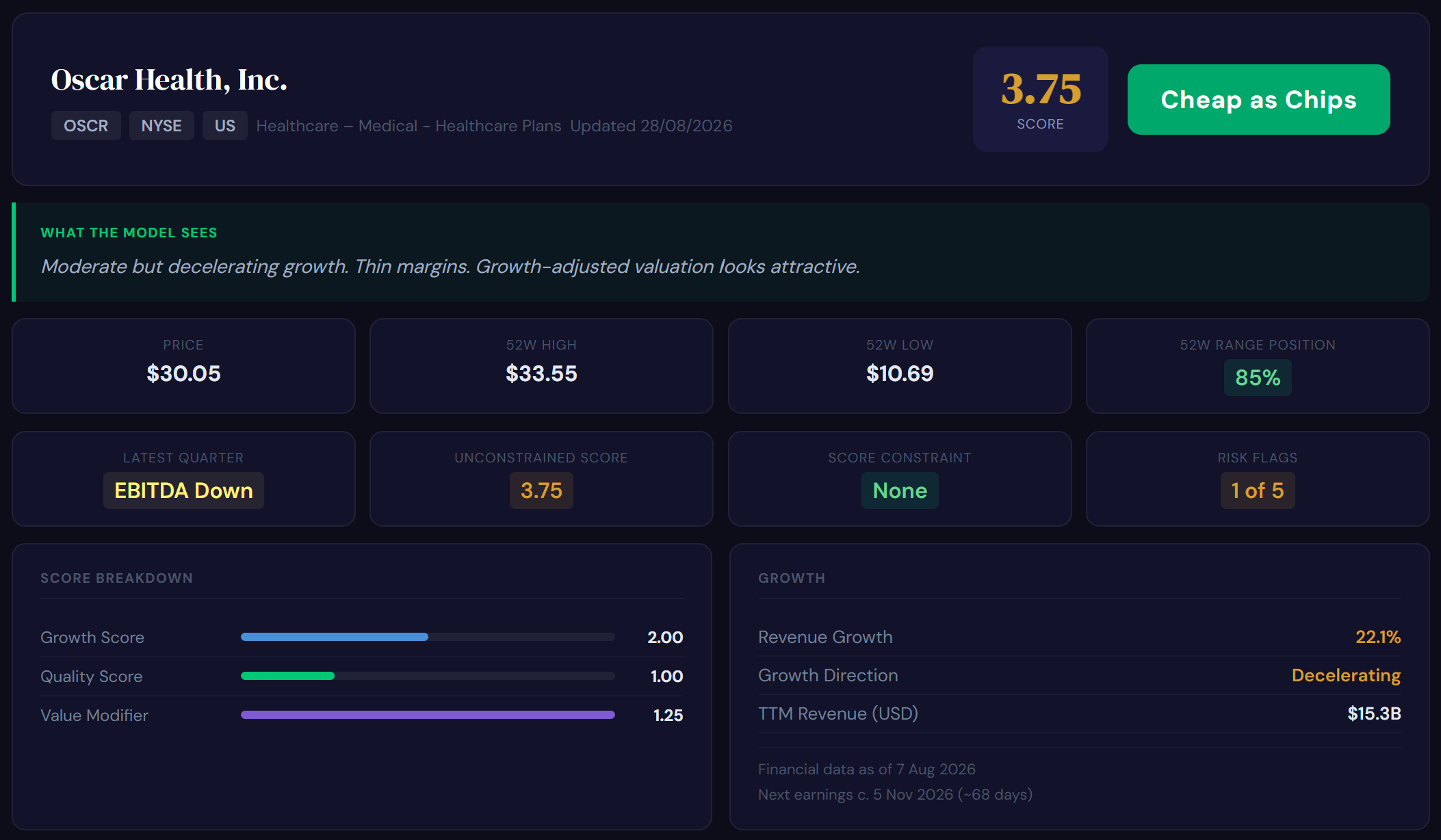
Oscar Health as the model read it in late August 2026. The value signal describes the price. The score describes the whole picture. Here they disagree, and the disagreement is the point.
Two things worth noticing in how the scores behave. First, a single weak dimension caps the whole score. A company cannot buy its way to a high score with spectacular growth if the quality or the price is wrong, because in real life the weak dimension is what gets you. Second, risk here is detected, not predicted. We run five specific checks against each company's own filings, cash flow, debt, share dilution, reporting jurisdiction, and accounting quality, and flag what trips. A flag is a smoke detector, not a forecast. Zero flags does not mean safe. It means today's filings pass five specific tests, nothing more, and anyone who tells you a stock is "all clear" is telling you about their marketing, not their analysis.
How we talk about price
Numbers like valuation multiples make beginners' eyes glaze, so we translate the price question into plain English. Every scored company carries one of seven labels:

The labels are descriptions of price against growth, not instructions. A company can be wonderful and Full Price at the same time. That combination is exactly the trap this guide exists to help you see.
Four mistakes that cost beginners the most

Assuming last year repeats. Growth slows as companies scale. The question is whether the slowdown is gradual or structural.
Ignoring price in a bull market. It feels irrelevant right up until it is the only thing that matters.
Reading revenue as health. Revenue can grow while the business underneath deteriorates. Pair every growth number with a quality number.
Falling for the story. Great narratives are not great businesses. The numbers have to keep agreeing with the story, quarter after quarter.
If you remember three things
A great company and a great investment are different claims. Growth only counts if it lasts, and quality is what makes it last. And the price you pay is a judgement you make, not a detail you skip.
That is the foundation. Everything else we publish builds on it.